
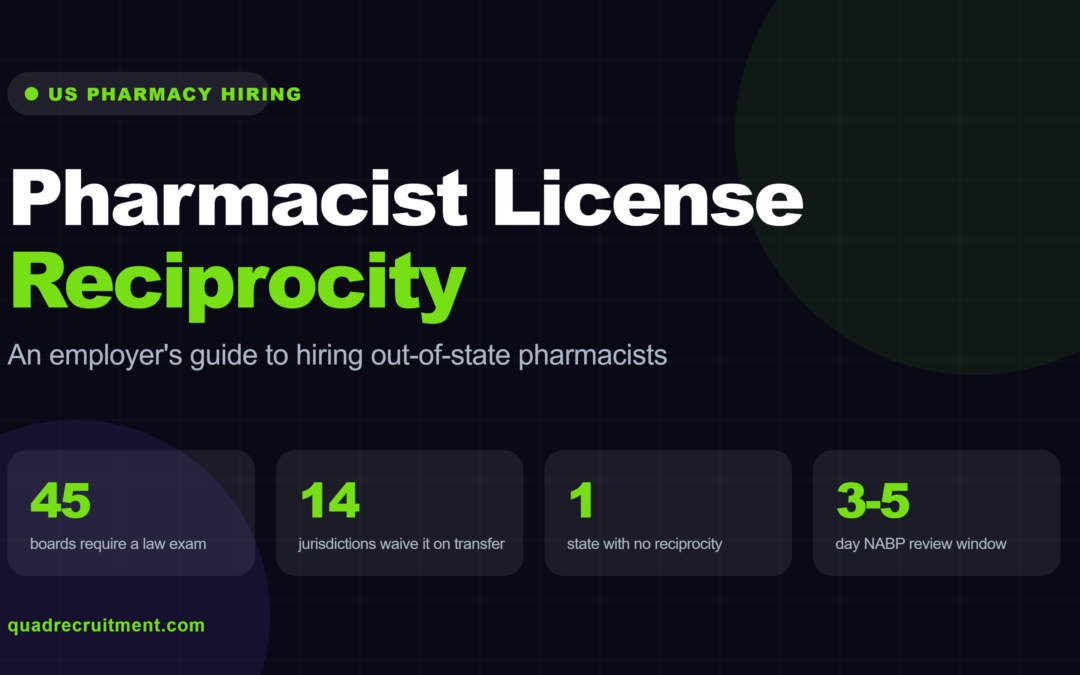
You found the right pharmacist. They accepted. Then nothing happened for eleven weeks, because nobody in the process owned the licensure question. Pharmacist license reciprocity is the single most underestimated cause of a slow pharmacist hire in the United States, and it is almost entirely predictable if you check the right things before you make the offer.
This is a guide for pharmacy owners, hiring managers, directors of pharmacy and multi-site operators. It covers how pharmacist license transfer works through the NABP, which states require the MPJE, which states do not allow pharmacist licensure by reciprocity at all, the state rules that quietly add weeks to your start date, and what pharmacy technician license requirements by state do to the rest of your rota.
None of this is legal advice, and boards of pharmacy change their rules. Always confirm current requirements with the relevant state board before you commit to a start date.
What this guide covers
- Licensure is a hiring problem, not a candidate problem
- How pharmacist license reciprocity actually works
- The MPJE and which states require it
- States where pharmacist reciprocity does not exist
- State rules that quietly add weeks
- Pharmacy technician license requirements by state
- What this does to your time to fill
- Seven ways to cut licensure delay out of hiring
- How we handle licensure for our clients
- Pharmacist licensure FAQ for employers
Licensure is a hiring problem, not a candidate problem
Most employers treat pharmacist licensure as paperwork the candidate deals with quietly in the background. That framing is where the delay comes from. The candidate does not know your rota pressure, your board does not answer to your opening date, and nobody in the chain is being measured on how long the license takes.
The result is a familiar pattern. A vacancy sits open for six weeks while you search. You find a strong out-of-state pharmacist, run a good process, make a competitive offer, and then discover that the state you are hiring into requires a jurisprudence exam with a limited testing window, or twelve months of prior licensure, or an entirely fresh examination route. Your effective time to fill was never the six weeks you measured. It was closer to four months.
Two things follow. First, licensure status belongs in your screening criteria from day one, not in onboarding. Second, the candidates who are already licensed in your state are worth moving on faster than most employers do, which is the same lesson we covered in why great interviews still end in declined offers.
The short version
Ask three questions before you shortlist an out-of-state pharmacist: which states do they currently hold an active license in, have they already passed the law exam for your state, and have they started an NABP licensure transfer. Those three answers predict your start date more accurately than anything else on the resume.
How pharmacist license reciprocity actually works
What employers call reciprocity, the profession calls licensure transfer. It runs through the National Association of Boards of Pharmacy and its Electronic Licensure Transfer Program, usually shortened to eLTP. The NABP verifies the pharmacist's credentials and runs background screening through the NABP Clearinghouse, but the receiving state board still makes the final licensing decision.
The program covers all fifty states plus the District of Columbia, Guam, Puerto Rico and the US Virgin Islands, and it also supports transfer into New Brunswick, Nova Scotia and Prince Edward Island. To be eligible, a pharmacist must hold at least one license that is current, active, unrestricted and in good standing.
| Stage | What happens | Who controls the clock |
|---|---|---|
| 1. Check requirements | General eLTP criteria plus the target state's own conditions | Candidate |
| 2. Confirm exam needs | Whether the state requires the MPJE or UMPJE for transfer | State board |
| 3. Prepare documents | Passport photo, education history, employment history, license details | Candidate |
| 4. Submit through NABP e-Profile | All target states listed in one submission | Candidate |
| 5. NABP review | Verification and Clearinghouse screening, stated at 3 to 5 business days | NABP |
| 6. Board decision | Final license issued, timing varies widely by state | State board |
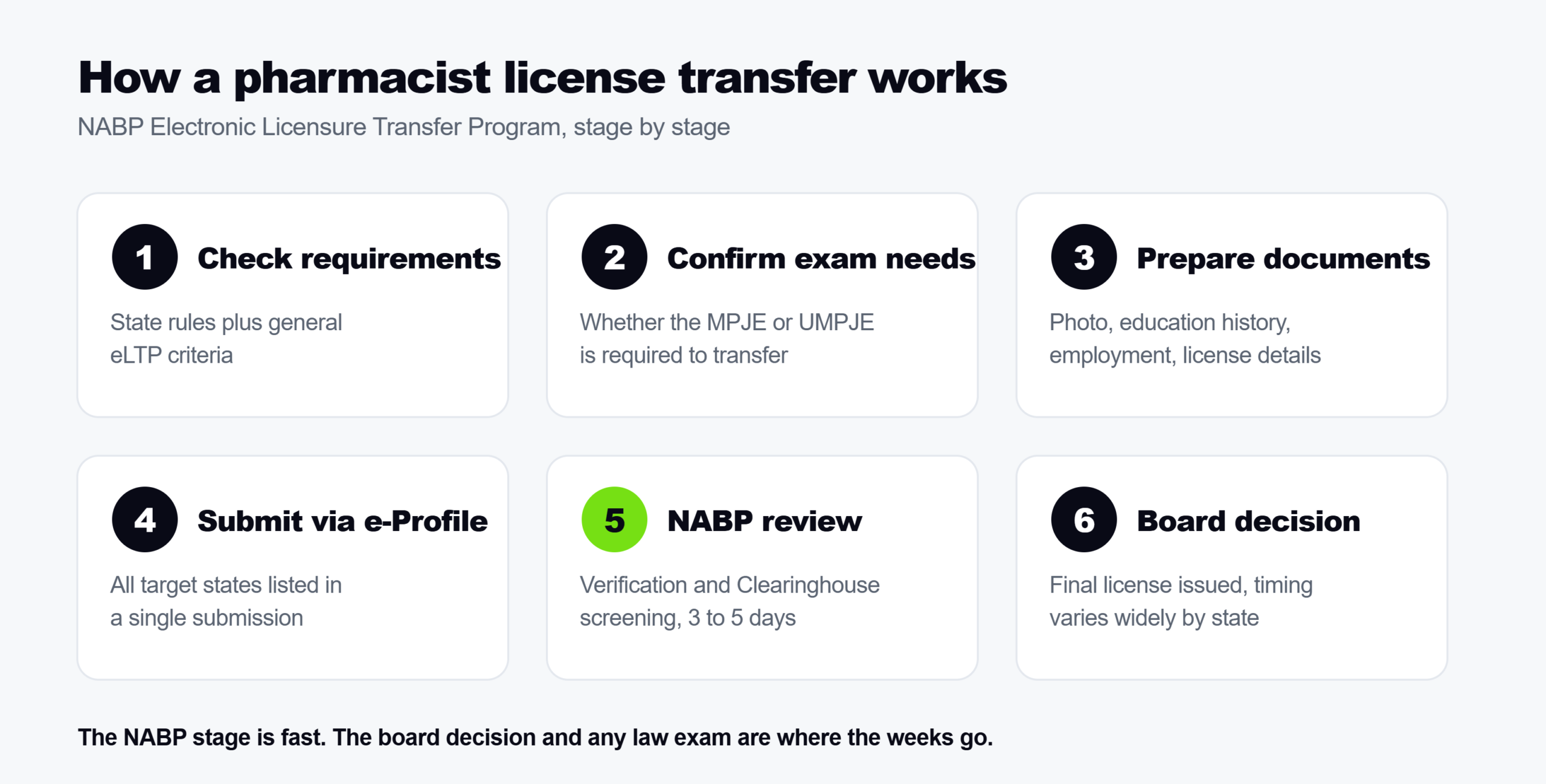
Fees at the time of writing are 300 dollars for the application plus 100 dollars per jurisdiction, with discounts for active armed forces members and veterans. Those numbers matter less than the sequencing. The NABP review is fast. The board decision and the law exam are where months disappear.
One practical point that employers consistently miss: a pharmacist should list every state they might realistically work in on a single submission rather than transferring one state at a time. If you operate across state lines, or run mail order pharmacy or central fill sites where multi-state licensure is standard, say so during the interview. It changes what the candidate files.
The MPJE and which states require it
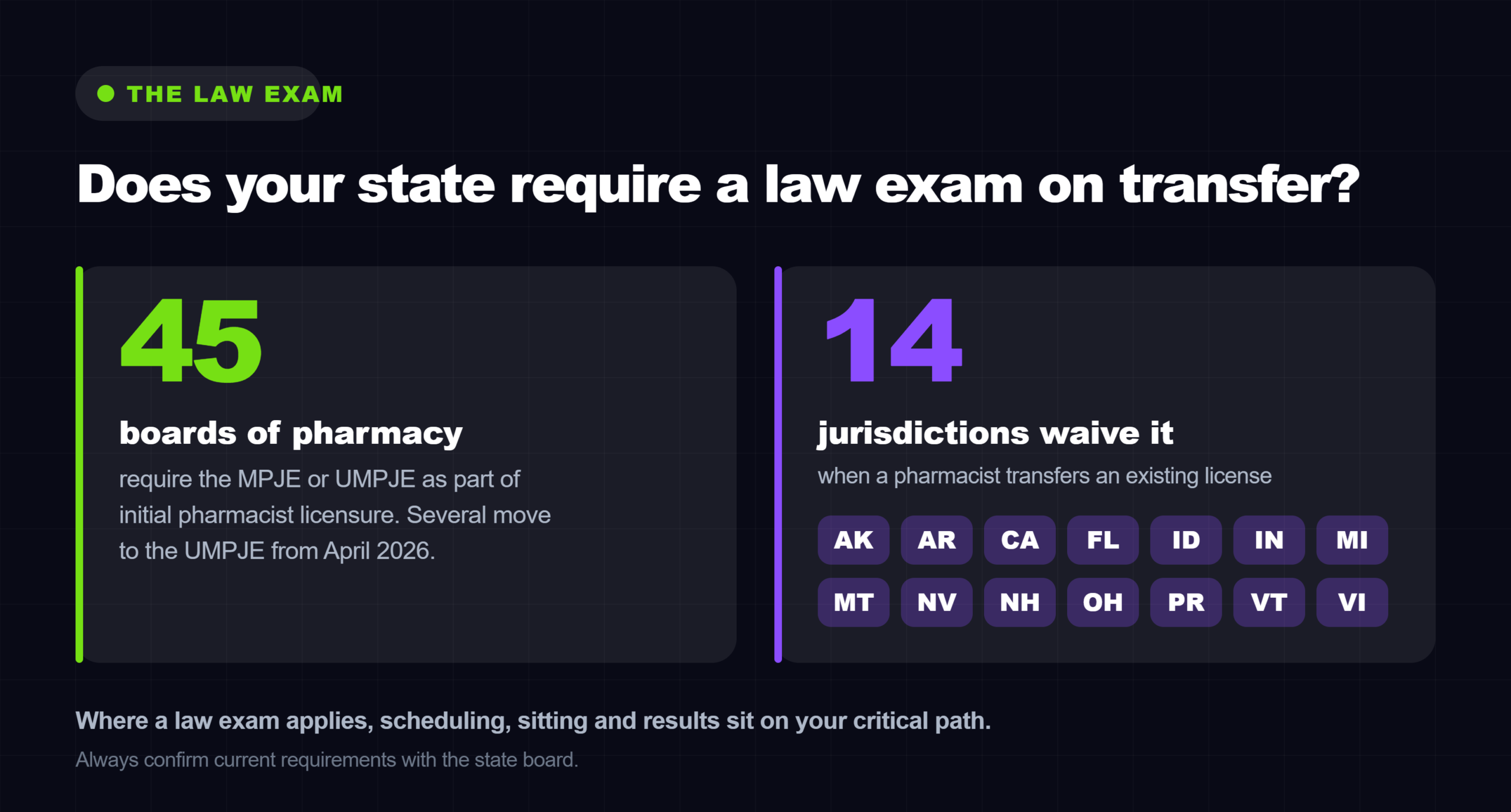
The Multistate Pharmacy Jurisprudence Examination is the law exam that gates most pharmacist licenses. Forty-five boards of pharmacy require the MPJE or the newer Uniform MPJE as part of initial licensure, with several jurisdictions moving onto the UMPJE from April 2026.
For hiring purposes, the more useful list is the shorter one. Fourteen jurisdictions do not require the NABP law exam when a pharmacist transfers an existing license in: Alaska, Arkansas, California, Florida, Idaho, Indiana, Michigan, Montana, Nevada, New Hampshire, Ohio, Puerto Rico, Vermont and the US Virgin Islands. Florida accepts the MPJE or another nationally recognized exam.
If you are hiring into any of the other states, the law exam sits on your critical path. Scheduling, sitting and receiving a result is rarely a same-week affair, and a failed attempt carries a mandatory wait before a retake. When a candidate tells you they have already passed the MPJE for your state, that is worth real money in reduced time to fill, and it is worth asking about explicitly rather than hoping it surfaces.
States where pharmacist reciprocity does not exist
California is the outlier every US pharmacy employer needs to know about, and it catches out national operators constantly. The California State Board of Pharmacy states plainly that California law does not allow for reciprocity, and that applicants are required at minimum to take and pass both the NAPLEX and the CPJE, the California specific jurisprudence exam.
There is one narrowing of that burden. A pharmacist who holds an active license in another state may be able to transfer a previously passing NAPLEX score, provided it was passed on or after 1 January 2004 and rests on a current or recent occupational analysis. The CPJE still has to be passed separately.
What this means if you hire in California
Treat an out-of-state pharmacist as an examination candidate, not a transfer candidate. Plan for a materially longer runway than any other state, and weight your search towards pharmacists who already hold a California license. Our California pharmacy jobs page is built around exactly that pool.
A handful of other jurisdictions carry unusual conditions rather than a flat bar. Michigan, Oklahoma and the Virgin Islands direct certain transfer applicants to contact the licensing board directly, which in practice means the timeline cannot be estimated from published rules alone.
State rules that quietly add weeks
Beyond the law exam, several boards attach experience or tenure conditions to licensure transfer. These rarely appear in job adverts or candidate conversations, and they are the most common cause of an offer that cannot start on time.
| Requirement type | Jurisdictions | Effect on hiring |
|---|---|---|
| Minimum time already licensed | Colorado, Oregon, South Dakota and Tennessee require one year; Arkansas requires six months | Rules out recently licensed pharmacists entirely |
| Recent practice hours | New Jersey requires 1,500 active practice hours within the previous two years | Rules out career returners and part-time locums |
| Post-graduation hours | Maryland requires 520 hours of active practice after graduation | Affects new graduates transferring early |
| Additional examination | Georgia requires a practical examination alongside the law exam | Adds a scheduling dependency |
| Comparable internship | Missouri requires an internship comparable to its own standard | Adds documentation and review time |
| Board contact required | Michigan, Oklahoma and the Virgin Islands in certain cases | Timeline cannot be predicted in advance |
Read that table as a screening tool rather than a legal reference. If you are recruiting in Colorado, Oregon, South Dakota or Tennessee, a pharmacist eleven months into their first license is not a viable candidate this quarter no matter how good the interview is. If you are recruiting in New Jersey, a pharmacist who has been out of practice for two years has a problem you need to surface in the first conversation.
Pharmacy technician license requirements by state
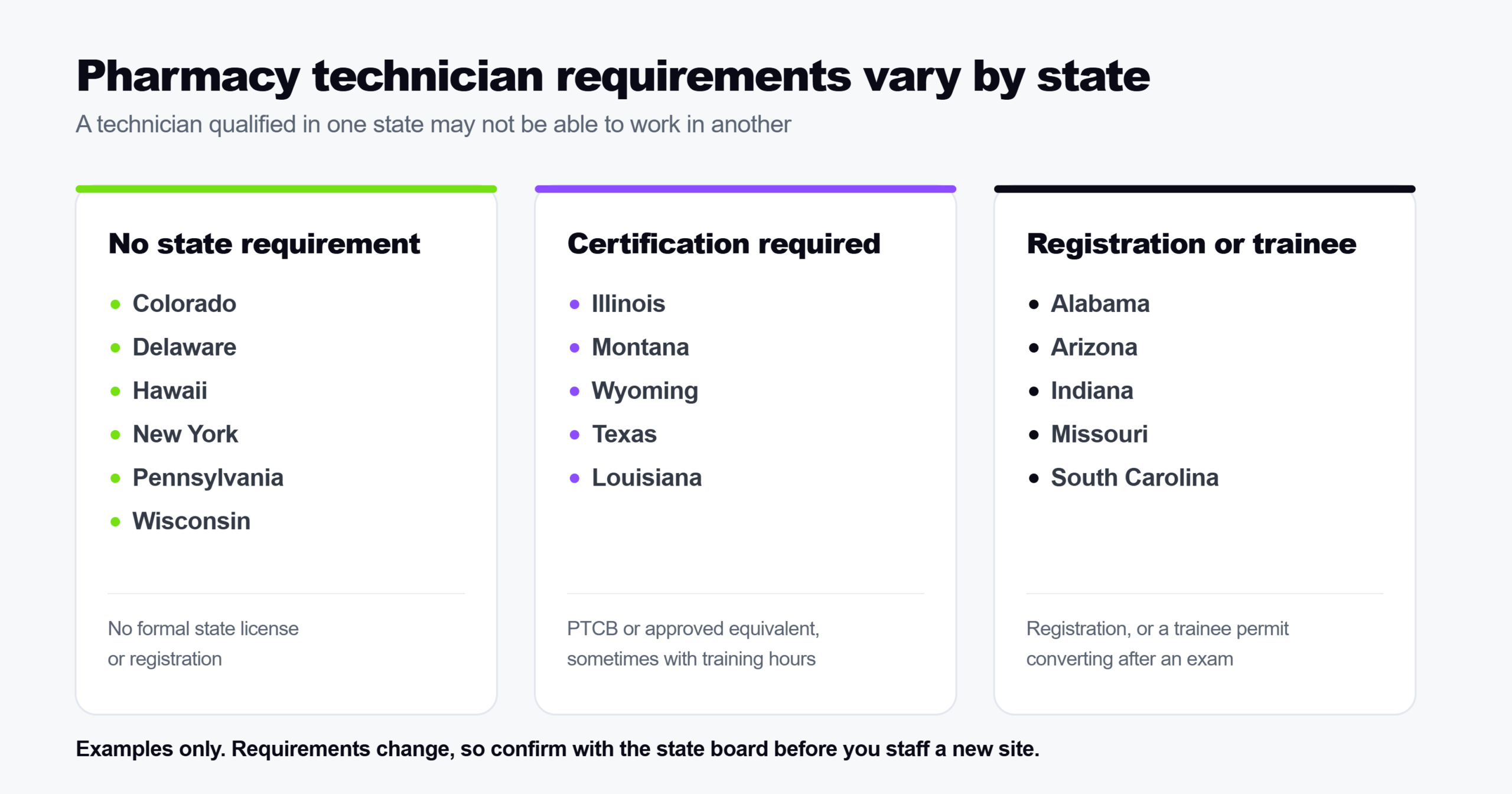
Pharmacist licensure gets the attention, but technician rules vary far more dramatically and they govern whether your pharmacist can actually operate at capacity once they start.
Some states impose no formal technician requirement at all, including Colorado, Delaware, Hawaii, New York, Pennsylvania and Wisconsin. Others require national certification through the PTCB or an approved equivalent, including Illinois, Montana and Wyoming. Texas requires board-approved training plus PTCB certification, and Louisiana requires 600 hours of on the job training plus certification. Several states sit in between with registration only, or with a trainee pathway that converts to full registration after an exam.
The practical consequence is that a technician who is fully qualified in one state may be unable to work in another without months of training and examination. If you are opening a site in a new state, or moving a team across state lines, model the technician pipeline before you model the pharmacist pipeline. Our pharmacy technician recruitment page covers how we build those pipelines by state.
What this does to your time to fill
Put the pieces together and a realistic hiring timeline for an out-of-state pharmacist looks nothing like the internal target most pharmacy operators carry.
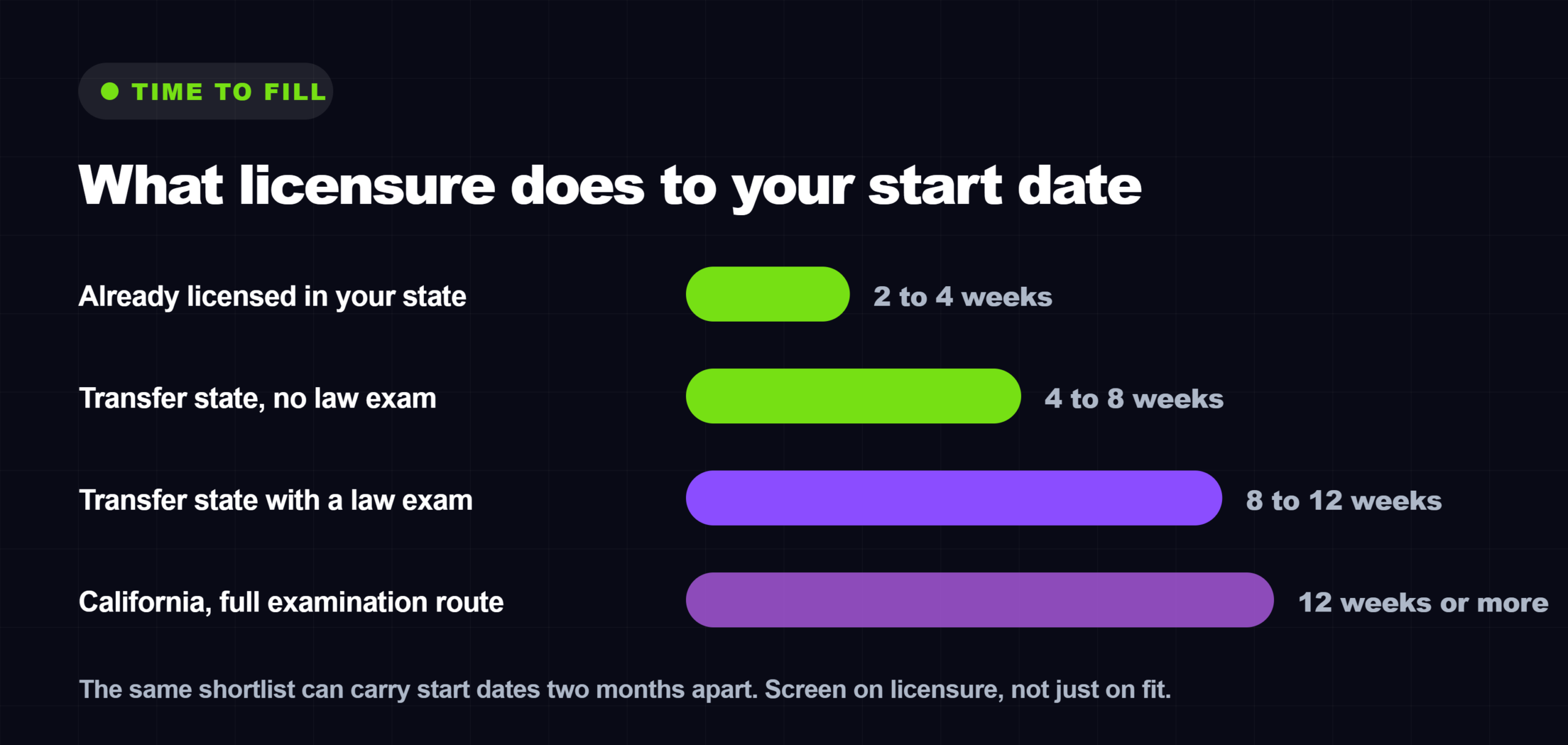
- Best case: candidate already licensed in your state, offer to start in two to four weeks, limited only by their notice period.
- Common case: transfer state with a law exam requirement, add scheduling, sitting and result time to the board's own processing, and plan for two to three months.
- Slow case: a state with a tenure or practice-hour condition, or a board that requires direct contact, and the start date becomes genuinely hard to forecast.
- California: a full examination route, and a runway that should be planned in months rather than weeks.
This is the arithmetic behind something we wrote about earlier this year in the biggest hiring mistake in US healthcare right now. Vacancies do not stay open because the market is empty. They stay open because the process was built for a timeline the regulation does not allow.
Seven ways to cut licensure delay out of hiring
- Screen on licensure: capture current active state licenses and law exam status in the first conversation, not at offer stage.
- Split your shortlist: run already-licensed candidates and transfer candidates as two separate tracks with two separate start dates.
- Move faster on in-state: a pharmacist licensed in your state can start weeks sooner, so your process should reflect that value.
- Start the transfer early: encourage a candidate to file with the NABP at offer stage rather than after contracts are signed.
- List every state at once: for multi-site and mail order operations, a single multi-jurisdiction submission avoids repeat cycles later.
- Check temporary license options: some boards offer temporary or emergency permits that let a pharmacist begin while the full license completes. Confirm availability with the board directly.
- Budget for the transfer: covering NABP fees and exam costs is a cheap, visible signal in a market where counter-offers are routine.
The last point deserves emphasis. Licensure costs are small compared with the revenue lost to an unfilled pharmacist in charge position, but candidates read who pays as a statement about how the employer treats people.
How we handle licensure for our clients
Licensure status is part of how we qualify every pharmacist before you see a CV. When we send a shortlist, each candidate arrives with their active state licenses, their law exam position and their realistic earliest start date attached, so you are comparing start dates rather than discovering them.
That applies across every setting we recruit for in the United States:
- Retail: retail pharmacy recruitment across chain and independent operators.
- Hospital: hospital pharmacy recruitment, including clinical and residency-trained pharmacists.
- Long-term care: long-term care pharmacy recruitment for closed-door and consultant roles.
- Specialty: specialty pharmacy recruitment and specialty infusion management.
- Compounding: compounding pharmacy recruitment across 503A and 503B facilities.
- Mail order: mail order pharmacy recruitment where multi-state licensure is the norm.
- Nuclear: nuclear pharmacy recruitment with its own authorized user requirements.
- Leadership: directors of pharmacy and C-suite pharmacy executives.
You can see the full range on our USA specialisms hub, or read how we work with employers on the employers page. If you want the candidate's view of how these settings differ, our guide to eight pharmacy settings on one license covers it in detail.
Pharmacist licensure FAQ for employers
What is pharmacist license reciprocity?
Reciprocity, more accurately called licensure transfer, is the process that lets a pharmacist already licensed in one US state become licensed in another without repeating the full examination route. It runs through the NABP Electronic Licensure Transfer Program, and the receiving state board makes the final decision.
How long does a pharmacist license transfer take?
The NABP states it reviews a submitted application within three to five business days, but board processing after that varies widely, and any required law exam adds scheduling and result time. For planning purposes, two to three months is a realistic assumption in most transfer states, with longer timelines where extra conditions apply.
Which states do not accept pharmacist reciprocity?
California is the clearest example. The California State Board of Pharmacy states that California law does not allow for reciprocity, and out-of-state pharmacists must pass both the NAPLEX and the CPJE, although a qualifying NAPLEX score passed on or after 1 January 2004 may be transferable. Several other jurisdictions impose conditions strict enough to have a similar practical effect.
Does every state require the MPJE for a license transfer?
No. Fourteen jurisdictions waive the NABP law exam for licensure transfer, including Alaska, Arkansas, California, Florida, Idaho, Indiana, Michigan, Montana, Nevada, New Hampshire, Ohio, Puerto Rico, Vermont and the US Virgin Islands. Most other states do require it, so confirm with the specific board.
Can a pharmacist start work before the license is issued?
In some states a temporary or emergency permit allows limited practice while a full license is processed. Availability and conditions vary considerably, so this must be confirmed with the state board rather than assumed.
Do pharmacy technicians need a license in every state?
No. Colorado, Delaware, Hawaii, New York, Pennsylvania and Wisconsin have no formal state requirement, while states such as Illinois, Montana, Wyoming and Texas require national certification, sometimes alongside board-approved training. This variation matters when you are staffing a new site or moving a team across state lines.
Should the employer pay for licensure transfer?
There is no obligation, but in a competitive market it is a low-cost and highly visible signal. NABP fees and exam costs are small next to the cost of an unfilled pharmacist vacancy, and candidates weigh who pays when comparing offers.
Hiring a pharmacist across state lines
If licensure is holding up a vacancy, the fastest fix is usually a shortlist built around who can actually start, not just who looks best on paper. We qualify licensure status before you see a CV, across all fifty states.
Talk to our US team How we work with employers Browse USA specialisms
Call the US line on (857) 206-6893, or start with a state: Texas, Florida, New York and California.