
Most pharmacists pick their setting once, early, and then discover five years later that the choice was made for them by whoever happened to be hiring that spring. It does not have to work that way. The eight settings below all draw on the same license, but the day-to-day work, the hours, the pressure and the ceiling are so different that moving between them can feel like changing profession entirely.
This is a recruiter’s view rather than a careers-advisor’s view. We place into all eight of these settings across all 50 states, which means we hear the same complaints and the same relief from people moving in both directions. Here is what actually separates them.
The eight settings at a glance
| Setting | Typical hours | Patient contact | Main pressure |
|---|---|---|---|
| Retail | Days, evenings, weekends | Constant, face-to-face | Volume and wait times |
| Hospital | 24/7 rotation, weekends | Indirect, via care team | Acuity and coverage |
| Long-term care | Days plus on-call | Minimal, facility-facing | Cycle deadlines |
| Specialty | Business hours | High, by phone, ongoing | Payer approvals |
| Infusion | Business hours, some on-call | High, clinical | Scheduling and site-of-care |
| Compounding | Days, early starts | Low to none | Technique and documentation |
| Mail order | Shifts, often remote | None or phone-only | Throughput metrics |
| Nuclear | Very early starts | None | Half-life and precision |
Retail pharmacy
Still the largest employer of pharmacists in the country, and still the setting most people leave rather than the one they arrive at. The work is genuinely patient-facing — you are the most accessible healthcare professional most people ever meet — but it is delivered under volume and metric pressure that has intensified year on year.
Suits you if: you like the pace, you are good with people on their worst day, and you want geographic flexibility. Retail exists everywhere, which makes it the easiest setting to relocate within.
Watch for: technician hours are the single best predictor of whether a store is survivable. Ask about them before you ask about salary.
More detail on roles and store formats: retail pharmacy recruitment.
Hospital pharmacy
The setting most retail pharmacists say they want to move into, and the one with the highest barrier — residency training has become close to standard for clinical roles, and departments hire slowly because turnover is low.
Suits you if: you want clinical depth, board certification, and to be part of a care team rather than the last stop in a supply chain.
Watch for: “clinical pharmacist” means very different things in a 900-bed academic center and a 40-bed critical access hospital. Ask whether clinical time is protected or the first thing cut when the department is short.
More detail on facility types and specialties: hospital pharmacy recruitment.
Long-term care pharmacy
Closed-door work serving skilled nursing, assisted living, hospice and behavioral health facilities. No counter, no walk-ins, no queue — which for a lot of people leaving retail is the entire appeal.
Suits you if: you want clinical complexity without customer service, or you are drawn to consultant work — monthly drug regimen reviews and medication oversight carry real influence over prescribing.
Watch for: the pressure does not disappear, it changes shape. Cycle fill deadlines are absolute and on-call rotations are common.
More detail on facility types and the closed-door model: long-term care pharmacy recruitment.
Specialty pharmacy
High-cost therapies for complex conditions — oncology, rheumatology, multiple sclerosis, rare disease. You follow the same patients through diagnosis, approval, initiation and years of therapy, which produces a kind of continuity almost no other setting offers.
Suits you if: you want deep disease-state expertise and long relationships with a defined patient panel.
Watch for: most of the work, and most of the vacancies, sit on the access side — prior authorization, benefits investigation, appeals, copay assistance. If payer bureaucracy will grind you down, this is not the setting.
More detail on provider models and therapy areas: specialty pharmacy recruitment.
Infusion pharmacy
Closely tied to specialty, and frequently the same employer. Ambulatory infusion suites and home infusion providers need pharmacists who can handle sterile preparation, clinical monitoring and coordination with nursing teams.
Suits you if: you want clinical work with a hands-on component, and eventually a route into operational leadership. Infusion management is one of the clearer progression paths in pharmacy.
Watch for: site-of-care shifts and payer policy changes move this market quickly. It is growing, but not evenly.
More detail on leadership roles: specialty infusion manager recruitment.
Compounding pharmacy
Sterile and non-sterile preparation, split between 503A pharmacies dispensing patient-specific prescriptions and 503B outsourcing facilities producing in batches under current good manufacturing practice.
Suits you if: you are technically minded and take satisfaction in doing something precisely rather than quickly. Aseptic competency is scarce and slow to train, which gives experienced people real leverage.
Watch for: 503A and 503B are genuinely different jobs. Batch documentation, validation and quality systems experience does not transfer automatically in either direction.
More detail on USP chapters and facility types: compounding pharmacy recruitment.
Mail order pharmacy
Central fill facilities, PBM mail service operations and direct-to-consumer digital pharmacies. Home to some of the only genuinely remote pharmacist roles in the profession.
Suits you if: you want to work from home, or you want volume without the counter. Remote verification roles are real and they are not going away.
Watch for: two things. First, metrics follow you — scripts per hour and first-pass accuracy are measured continuously. Second, multi-state licensure is usually the gate. Pharmacists holding several active licenses have significantly more options.
More detail on operating models and licensure: mail order pharmacy recruitment.
Nuclear pharmacy
The smallest and most specialized setting in pharmacy. Preparing radiopharmaceuticals for imaging and, increasingly, for therapy — theranostics is the fastest-growing corner of the field.
Suits you if: you can face a start time in the small hours in exchange for finishing early, and you want technical work with almost no patient contact.
Watch for: authorization is a real gate. Becoming an authorized nuclear pharmacist requires didactic training and supervised experience, which is why employers sometimes sponsor training rather than wait for a qualified candidate to appear.
More detail on facility types and authorization: nuclear pharmacy recruitment.
How people actually move between settings
Career moves in pharmacy are not random. Some transitions happen constantly; others almost never do. The realistic routes:
- Retail to mail order — the most common move in the profession. Same core dispensing skill, no counter. The trade is metrics for queues.
- Retail to long-term care — straightforward for technicians, more of a step for pharmacists, but the closed-door environment is a genuine relief for many.
- Hospital to specialty — ambulatory care and oncology pharmacists are the natural feed into specialty clinical roles, particularly in health system specialty programs.
- Hospital IV room to compounding or infusion — the aseptic skill set transfers cleanly in every direction, and this is the most portable competency in pharmacy.
- Compounding to nuclear — less obvious, but sterile compounding experience is the strongest foundation for nuclear authorization when no authorized candidate is available locally.
- Anything to retail — always available, which is both the reassurance and the trap.
The transition that rarely works without preparation is jumping straight from retail into a hospital clinical role without residency training. It happens, but usually via a hospital staff or operations position first.
Three questions worth asking before you move
What does the schedule actually look like in month three? Not the advertised schedule. Every setting has a version of this — retail has floater coverage, hospital has weekend rotation, nuclear has the start time, mail order has peak season, long-term care has on-call.
Which licenses do you hold, and which should you hold? Multi-state licensure opens mail order and remote roles specifically. Reciprocity timelines vary considerably and are worth checking before you commit to a relocation.
Is this a move toward something or away from something? Both are legitimate. But people who move purely to escape tend to land somewhere with a different set of problems and be looking again within a year.
Where to start
If you are weighing a move, the useful conversation is about your specific market rather than the setting in general — what a hospital clinical role pays in your metro, whether specialty providers near you are hiring, how many nuclear pharmacies are within commuting distance. That varies enormously by state.
You can search current pharmacy jobs across all eight settings, browse the full list of USA pharmacy specialisms and state pages, or contact us confidentially to talk through the market before you apply anywhere.
Hiring rather than looking? Our employer page covers how we work, or call the US line on (857) 206-6893.
Most pharmacists pick their setting once, early, and then discover five years later that the choice was made for them by whoever happened to be hiring that spring. It does not have to work that way.
The eight settings below all draw on the same license, but the hours, the pressure, the patient contact and the ceiling are so different that moving between them can feel like changing profession entirely.
This is a recruiter's view rather than a careers-advisor's view. We place into all eight of these settings across all 50 states, which means we hear the same complaints and the same relief from people moving in both directions. Here is what actually separates them.
The eight settings
The eight settings at a glance
| Setting | Typical hours | Patient contact | Main pressure | Explore roles |
|---|---|---|---|---|
| Retail | Days, evenings, weekends | Constant, face to face | Volume and wait times | Retail pharmacist |
| Hospital | 24/7 rotation, weekends | Indirect, via care team | Acuity and coverage | Hospital pharmacy |
| Long-term care | Days plus on-call | Minimal, facility facing | Cycle deadlines | Long-term care |
| Specialty | Business hours | High, by phone, ongoing | Payer approvals | Specialty pharmacy |
| Infusion | Business hours, some on-call | High, clinical | Scheduling and site of care | Infusion management |
| Compounding | Days, early starts | Low to none | Technique and documentation | Compounding pharmacy |
| Mail order | Shifts, often remote | None or phone only | Throughput metrics | Mail order pharmacy |
| Nuclear | Very early starts | None | Half-life and precision | Nuclear pharmacy |

1. Retail pharmacy
Still the largest employer of pharmacists in the country, and still the setting most people leave rather than the one they arrive at. The work is genuinely patient facing, and you are the most accessible healthcare professional most people ever meet, but it is delivered under volume and metric pressure that has intensified year on year.
- Suits you if: you like the pace, you are good with people on their worst day, and you want geographic flexibility. Retail exists everywhere, which makes it the easiest setting to relocate within.
- Watch for: technician hours are the single best predictor of whether a store is survivable. Ask about them before you ask about salary.
- Go deeper: retail pharmacist recruitment covers roles and store formats.
2. Hospital pharmacy
The setting most retail pharmacists say they want to move into, and the one with the highest barrier. Residency training has become close to standard for clinical roles, and departments hire slowly because turnover is low.
- Suits you if: you want clinical depth, board certification, and to be part of a care team rather than the last stop in a supply chain.
- Watch for: "clinical pharmacist" means very different things in a 900-bed academic center and a 40-bed critical access hospital. Ask whether clinical time is protected or the first thing cut when the department is short.
- Go deeper: hospital pharmacy recruitment covers facility types and specialties, and director of pharmacy roles sit at the top of this route.
3. Long-term care pharmacy
Closed-door work serving skilled nursing, assisted living, hospice and behavioral health facilities. No counter, no walk-ins, no queue, which for a lot of people leaving retail is the entire appeal.
- Suits you if: you want clinical complexity without customer service, or you are drawn to consultant work. Monthly drug regimen reviews and medication oversight carry real influence over prescribing.
- Watch for: the pressure does not disappear, it changes shape. Cycle fill deadlines are absolute and on-call rotations are common.
- Go deeper: long-term care pharmacy recruitment covers facility types and the closed-door model.
4. Specialty pharmacy
High-cost therapies for complex conditions: oncology, rheumatology, multiple sclerosis and rare disease. You follow the same patients through diagnosis, approval, initiation and years of therapy, which produces a kind of continuity almost no other setting offers.
- Suits you if: you want deep disease-state expertise and long relationships with a defined patient panel.
- Watch for: most of the work, and most of the vacancies, sit on the access side: prior authorization, benefits investigation, appeals and copay assistance. If payer bureaucracy will grind you down, this is not the setting.
- Go deeper: specialty pharmacy recruitment covers provider models and therapy areas.
5. Infusion pharmacy
Closely tied to specialty, and frequently the same employer. Ambulatory infusion suites and home infusion providers need pharmacists who can handle sterile preparation, clinical monitoring and coordination with nursing teams.
- Suits you if: you want clinical work with a hands-on component, and eventually a route into operational leadership. Infusion management is one of the clearer progression paths in pharmacy.
- Watch for: site-of-care shifts and payer policy changes move this market quickly. It is growing, but not evenly.
- Go deeper: specialty infusion manager recruitment covers the leadership roles.
6. Compounding pharmacy
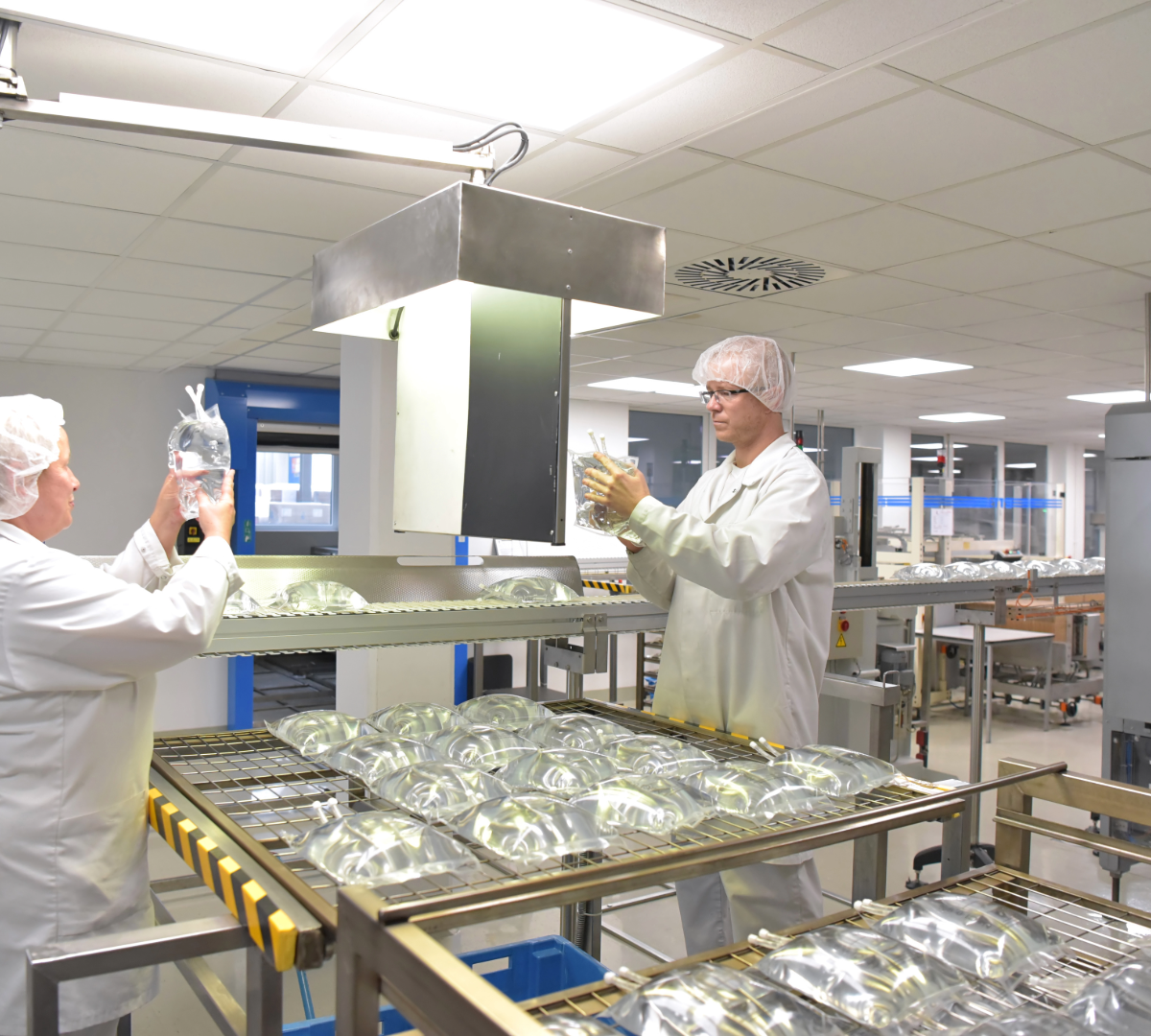
Sterile and non-sterile preparation, split between 503A pharmacies dispensing patient-specific prescriptions and 503B outsourcing facilities producing in batches under current good manufacturing practice.
- Suits you if: you are technically minded and take satisfaction in doing something precisely rather than quickly. Aseptic competency is scarce and slow to train, which gives experienced people real leverage.
- Watch for: 503A and 503B are genuinely different jobs. Batch documentation, validation and quality systems experience does not transfer automatically in either direction.
- Go deeper: compounding pharmacy recruitment covers USP chapters and facility types.
7. Mail order pharmacy
Central fill facilities, PBM mail service operations and direct-to-consumer digital pharmacies. Home to some of the only genuinely remote pharmacist roles in the profession.
- Suits you if: you want to work from home, or you want volume without the counter. Remote verification roles are real and they are not going away.
- Watch for: two things. Metrics follow you, because scripts per hour and first-pass accuracy are measured continuously. And multi-state licensure is usually the gate, so pharmacists holding several active licenses have significantly more options.
- Go deeper: mail order pharmacy recruitment covers operating models and licensure.
8. Nuclear pharmacy
The smallest and most specialized setting in pharmacy. Preparing radiopharmaceuticals for imaging and, increasingly, for therapy, with theranostics the fastest-growing corner of the field.
- Suits you if: you can face a start time in the small hours in exchange for finishing early, and you want technical work with almost no patient contact.
- Watch for: authorization is a real gate. Becoming an authorized nuclear pharmacist requires didactic training and supervised experience, which is why employers sometimes sponsor training rather than wait for a qualified candidate to appear.
- Go deeper: nuclear pharmacy recruitment covers facility types and authorization.
How people actually move between settings
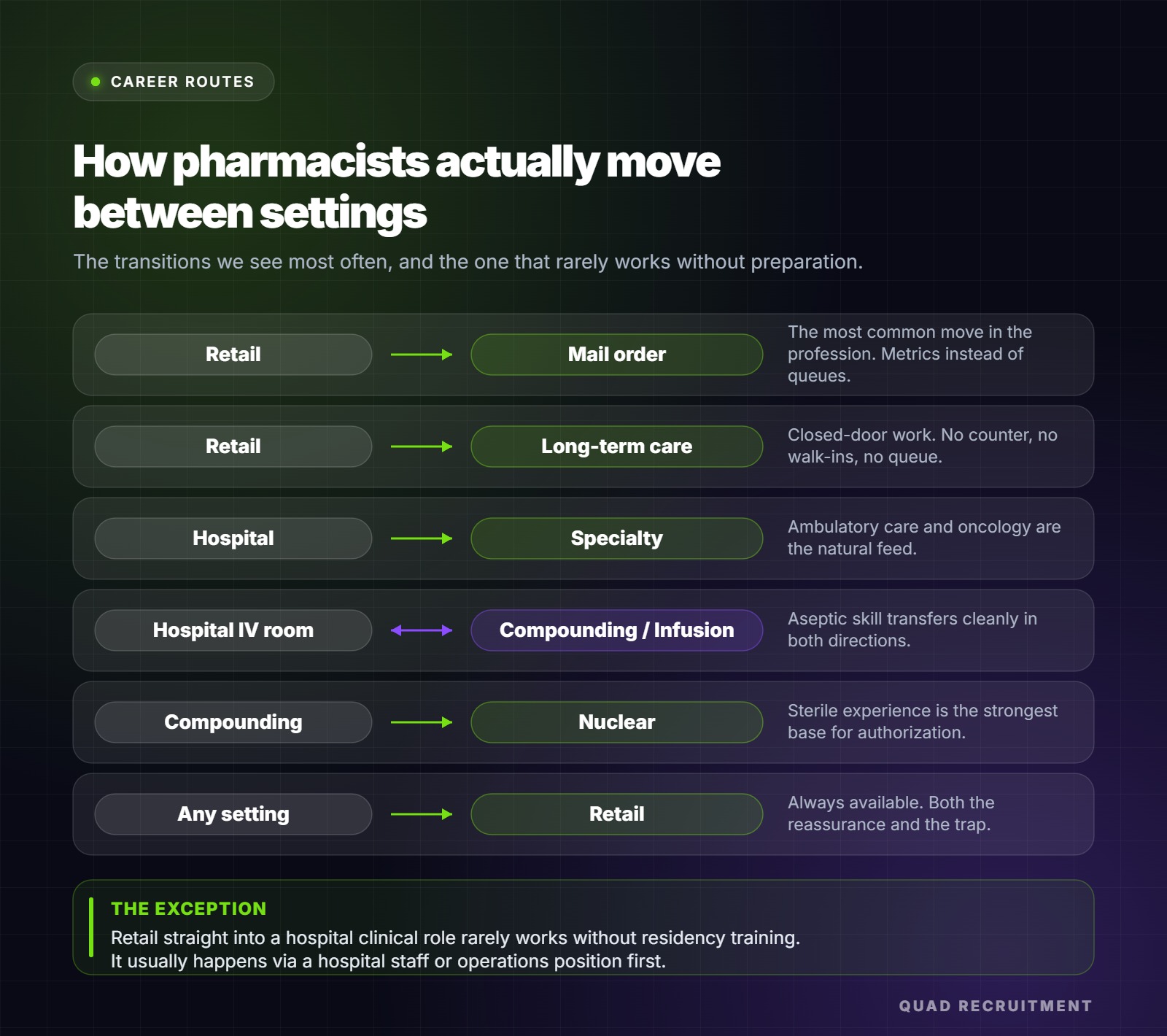
Career moves in pharmacy are not random. Some transitions happen constantly, others almost never do. These are the realistic routes.
| The move | Why it works |
|---|---|
| Retail to mail order | The most common move in the profession. Same core dispensing skill, no counter. The trade is metrics for queues. |
| Retail to long-term care | Straightforward for technicians, more of a step for pharmacists, but the closed-door environment is a genuine relief for many. |
| Hospital to specialty | Ambulatory care and oncology pharmacists are the natural feed into specialty clinical roles, particularly in health system specialty programs. |
| Hospital IV room to compounding or infusion | The aseptic skill set transfers cleanly in every direction. This is the most portable competency in pharmacy. |
| Compounding to nuclear | Less obvious, but sterile compounding experience is the strongest foundation for nuclear authorization when no authorized candidate is available locally. |
| Anything to retail | Always available, which is both the reassurance and the trap. |
The one move that rarely works cold
Jumping straight from retail into a hospital clinical role without residency training. It happens, but usually via a hospital staff or operations position first.

Three questions worth asking before you move
1. What does the schedule actually look like in month three?
Not the advertised schedule. Every setting has a version of this: retail has floater coverage, hospital has weekend rotation, nuclear has the start time, mail order has peak season, long-term care has on-call.
2. Which licenses do you hold, and which should you hold?
Multi-state licensure opens mail order and remote roles specifically. Reciprocity timelines vary considerably and are worth checking before you commit to a relocation.
3. Is this a move toward something or away from something?
Both are legitimate. But people who move purely to escape tend to land somewhere with a different set of problems and be looking again within a year.
Frequently asked questions
Which pharmacy setting pays the most?
Nuclear, specialty and 503B compounding tend to sit at the top for staff pharmacists because the skill pool is smaller, and leadership roles in hospital and infusion carry the highest ceiling overall. Pay varies more by state and employer than by setting alone, which is why a market-specific conversation beats a national average.
Can you change pharmacy setting without retraining?
In most cases yes. Retail, mail order, long-term care and specialty all hire directly from one another. The exceptions are hospital clinical roles, which usually expect residency training, and nuclear pharmacy, which requires formal authorization.
Which pharmacy jobs can be done remotely?
Mail order and central fill verification roles are the main source of genuinely remote pharmacist work, with some specialty and utilization review positions also hiring remotely. Multi-state licensure is normally the requirement.
What is the best pharmacy setting to work in?
There is no single answer, because the right setting depends on the trade you are willing to make between patient contact, schedule control, clinical depth and pace. Use the comparison table above to shortlist two settings, then talk to people currently working in both.
Where to start
If you are weighing a move, the useful conversation is about your specific market rather than the setting in general: what a hospital clinical role pays in your metro, whether specialty providers near you are hiring, how many nuclear pharmacies are within commuting distance. That varies enormously by state.
Search pharmacy jobs Browse USA specialisms Talk to us confidentially
Hiring rather than looking? Our employer page covers how we work, or call the US line on (857) 206-6893.